
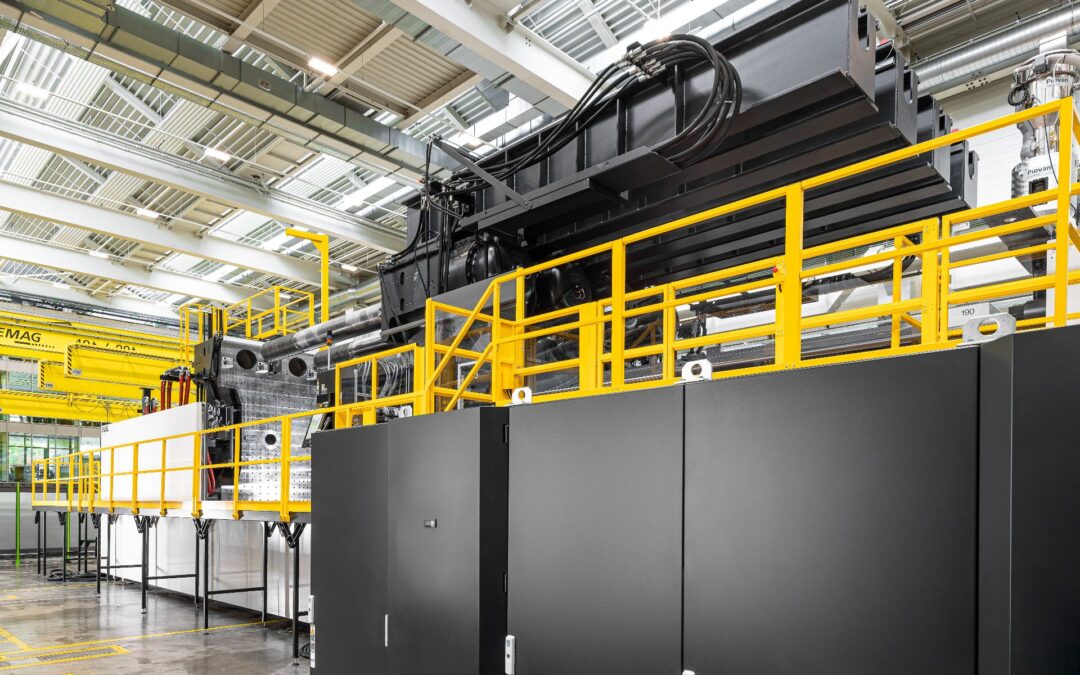
Gigamoulding and the ENGEL duo 12000t: a new dimension in the production of large plastic parts
When the production of large plastic components becomes faster, more cost-efficient and more technologically flexible, the way companies plan product development changes as well. That is exactly what the ENGEL duo 12000t delivers – a platform that opens a new phase in the plastics industry, while Neofyton provides complete support for implementing such solutions in practice.
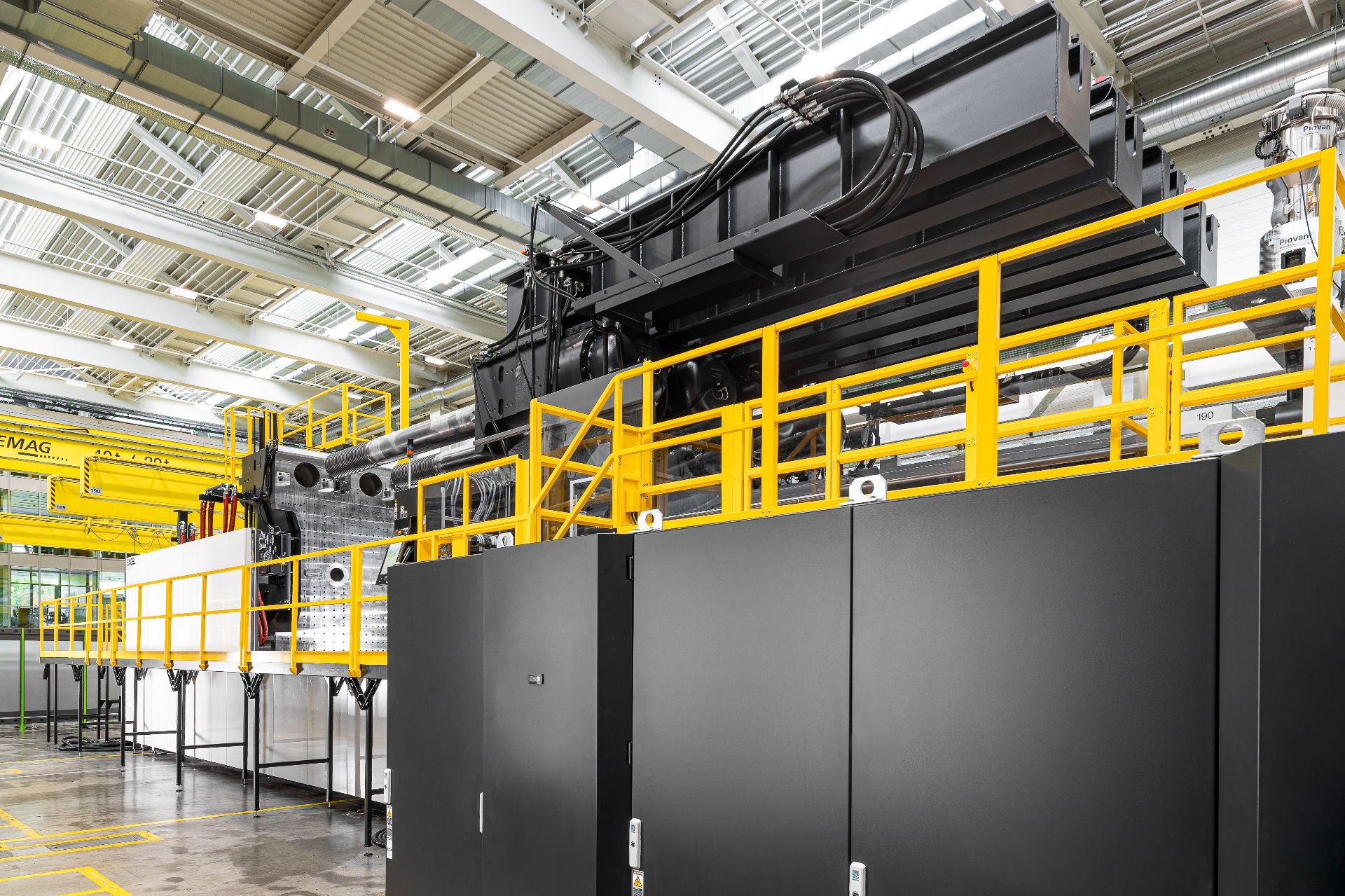
What does gigamoulding mean for modern plastics production?
In conventional manufacturing models, large products are often created through multiple individual components that are later joined, welded, additionally processed or assembled. This approach increases the number of operations, extends production flow and raises total costs.
Gigamoulding changes the logic of manufacturing. Instead of a multi-part structure, a large part is designed to be produced as a functionally integrated whole, or with a significantly reduced number of components. This reduces intermediate steps, simplifies production organisation and improves overall system efficiency.
For manufacturers, this means less downtime, better quality control, a more stable process and faster time to market. At the same time, it opens new possibilities in part design, since engineers are no longer limited by older production compromises.
The ENGEL duo 12000 is not just a large machine – it is a new production platform
The ENGEL duo 12000t was developed for parts with very large projected areas and applications that require high clamping force, process stability and controlled filling of large moulds. However, the greatest value of this machine lies not only in its impressive dimensions, but in the fact that it enables a new production economy.
| Key characteristic | Value |
|---|---|
| Clamping force | 110,000 kN |
| Machine length | approx. 24 m |
| Height | approx. 8.4 m |
| Total weight | 551 t |
| Maximum mould weight | 170 t |
| Shot volume | up to 65,000 cm³ |
| Injection configuration | two injection units operating in parallel |
Two injection units operating in parallel enable homogeneous filling of large areas and stable process results even for particularly demanding components. This is crucial for large structural parts, where uniform filling, precision and repeatability are essential for final product quality.
Video: see how the ENGEL duo 12000 performs in practice
Large dimensions, but also the precision required for demanding applications
When large machines are discussed, the first things usually mentioned are force, size and capacity. However, in serious industrial production, precision is equally important. That is why it is important to emphasise that such a system is not intended only for “large parts”, but also for complex components that require a high level of process control.
Advanced options such as injection compression moulding provide additional control over part quality and geometry. This opens the way for the production of large thin-wall structures, functionally integrated components and parts with strictly defined requirements in terms of stability and repeatability.
Where the biggest benefits are seen: automotive, infrastructure and technical products
Automotive industry and electromobility
In the automotive industry, the trend is moving toward reduced vehicle weight, greater functional integration and more rationalised production. Large plastic parts, such as battery housings, structural underbody elements, reinforced internal structures and other large technical components, can be produced with fewer assemblies and fewer operations.
This benefits both manufacturers and suppliers: lower cost per component, better process control, reduced assembly complexity and greater flexibility in product development.
Infrastructure systems and water management
In addition to the automotive sector, such machines open significant potential for infrastructure applications. Large tanks, rainwater management systems, infiltration elements and similar products can be manufactured more efficiently and with the advantages plastic offers compared to traditional materials.
Easier transport, simpler installation, resistance to environmental conditions and design flexibility make a strong case for the wider use of plastic systems in infrastructure.
Industrial and logistics products
Large technical and logistics components can also benefit from this approach. When the number of parts is reduced, the probability of errors is reduced as well, and production flow becomes clearer and more reliable. At the same time, it creates room for a higher degree of automation and more stable quality in serial production.
Why is gigamoulding important from a sustainability perspective?
Sustainability is no longer an added value, but part of a strategic manufacturing approach. When large parts are produced in fewer steps and with fewer components, the need for additional processing, internal transport, assembly and supporting resources is reduced.
In practice, this can mean:
- lower material consumption compared to multi-part systems,
- less waste and fewer intermediate steps,
- simplified production logistics,
- better use of time and capacity,
- a more favourable overall CO₂ footprint throughout the product life cycle.
That is why gigamoulding is not only a technological leap, but also an approach that supports more efficient and more responsible manufacturing.
Neofyton: from machine to complete turnkey system
The implementation of such advanced technologies does not depend only on the choice of machine. To achieve a stable and cost-effective result, the entire production setup must be aligned: material preparation and conveying, process temperature stability, automation, hot runner systems, lubrication, service and performance optimisation.
This is where Neofyton plays a key role. As a partner of leading global manufacturers, Neofyton provides not only equipment, but also design, integration and support for a complete solution tailored to the specific product and production capacity of the customer.
Partners that form the complete solution
- ENGEL – injection moulding machines and automation,
- Wintec – standard and reliable injection moulding solutions,
- Piovan – material conveying, drying and dosing,
- Frigel – process cooling, chillers and cooling towers,
- Oerlikon HRSflow – advanced hot runner systems,
- Campetella – robotics and production automation,
- MB Conveyors – conveying systems,
- TRIA – plastic grinding and recycling,
- IFW – tooling and engineering support,
- Texaco – industrial lubricants for stable and long-lasting equipment operation.
When all of these elements are properly aligned, the customer receives a functional and sustainable production system, not just a collection of individual devices.
What does the customer gain through the Neofyton approach?
The Neofyton approach is focused on real production results. This means that the solution is not viewed through a single machine, but through the complete production flow – from product requirements to stable serial operation.
- needs analysis and definition of the optimal production concept,
- selection of the machine and supporting equipment,
- integration of automation and peripheral systems,
- design of material and cooling systems,
- support during commissioning,
- process optimisation,
- service and long-term technical support.
This approach is especially important for large and investment-intensive projects, where every decision in design and integration directly affects productivity, quality and return on investment.
Frequently asked questions about gigamoulding and large injection moulding machines
Is gigamoulding intended only for the automotive industry?
No. Automotive is one of the most important sectors, but the potential also exists in infrastructure, water management, technical products, logistics and other fields where large plastic parts can replace more complex or heavier constructions.
Does a large machine automatically mean a more complicated process?
Not necessarily. When the whole system is properly designed, a large machine can simplify the process because it reduces the number of additional steps, operations and components that need to be joined or further processed later.
What is most important when planning such a project?
The most important thing is to treat the machine, mould, automation, material system, cooling and process support as one integrated whole. That is exactly why turnkey solutions are the safest route to stable and cost-effective production.
How to improve production with Neofyton support
If you are planning plant modernisation, development of large plastic components or implementation of advanced injection moulding technologies, the Neofyton team can help you define the optimal solution for your specific project.
More about the company: https://neofyton.com/
Contact page: https://neofyton.com/neofyton-contact/