
ENGEL at JEC World 2026: Automated Production of Composite Rotor Blades for Drones
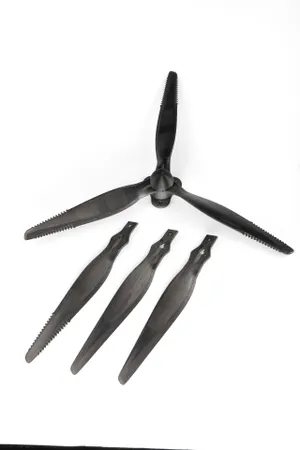
At JEC World 2026, ENGEL is presenting an innovative solution for the fully automated series production of thermoplastic composite rotor blades for drones. This technology combines low weight, high stiffness, functional integration and sustainability in one efficient manufacturing process.
At the trade fair, taking place from March 10 to 12, 2026 in Paris, ENGEL demonstrates how expertise in injection moulding and automation can be successfully applied to the production of high-performance lightweight composite components.
What is ENGEL presenting at JEC World 2026?
At the center of the presentation is a scalable manufacturing concept for composite rotor blades, designed to deliver high productivity, repeatable quality and a high degree of design freedom. It is an integrated process in which the following steps are combined within a single cycle:
- positioning of reinforcing layers,
- component forming,
- functional integration,
- demoulding of the finished part.
In this way, ENGEL transfers proven high-volume manufacturing principles into the field of thermoplastic composites, where the demands for strength, weight reduction and sustainability continue to grow.
Tape-sandwich injection moulding technology
The process is based on a sandwich structure made of carbon fibre reinforced thermoplastic tapes and injection-moulded short-fibre reinforced thermoplastic. The tapes form the outer load-bearing layers of the blade and are precisely positioned in the mould using vacuum fixation.
This allows the reinforcement to be placed exactly along the load paths, ensuring that material is used only where it is truly needed. In the next step, the short-fibre reinforced thermoplastic core is injected between the previously positioned tapes and bonded to the outer layers, creating a near-net-shape component.
To further reduce weight, chemical foaming of the core is used, achieving an even better balance between weight and performance. The result is a lightweight yet highly rigid composite rotor blade, ready for final trimming and use.

Lower weight, high stiffness and integrated functions
One of the major advantages of injection moulding is the possibility of high functional integration. In this application, noise-reducing elements such as serrated trailing edges can be integrated directly using suitable mould inserts, without additional post-processing steps.
This is especially important for modern drone applications, where acoustic performance is becoming increasingly relevant, particularly in urban environments. This approach makes it possible for the component to be not only lightweight and strong, but also functionally optimized for its intended application.
Fully automated production on the ENGEL victory machine
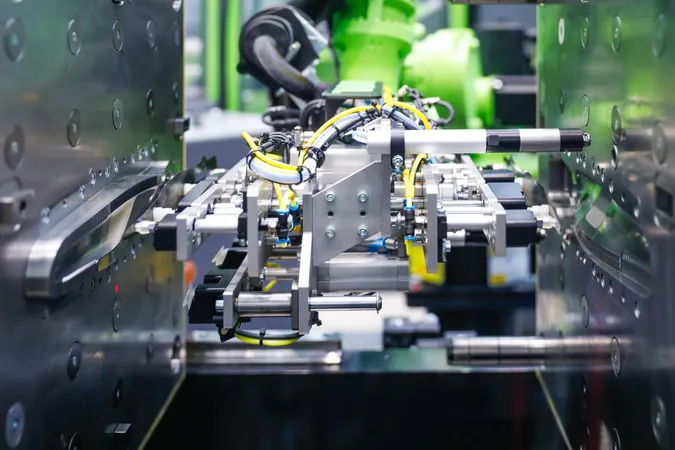
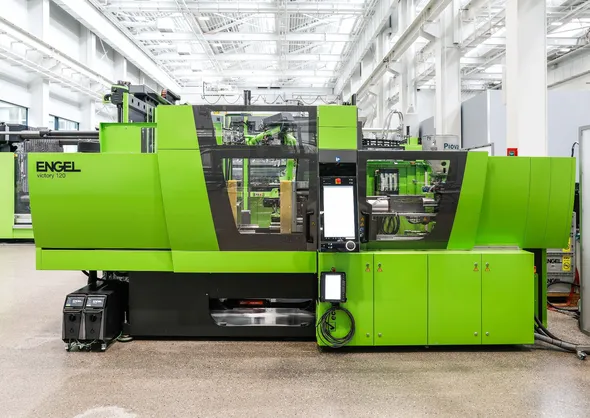
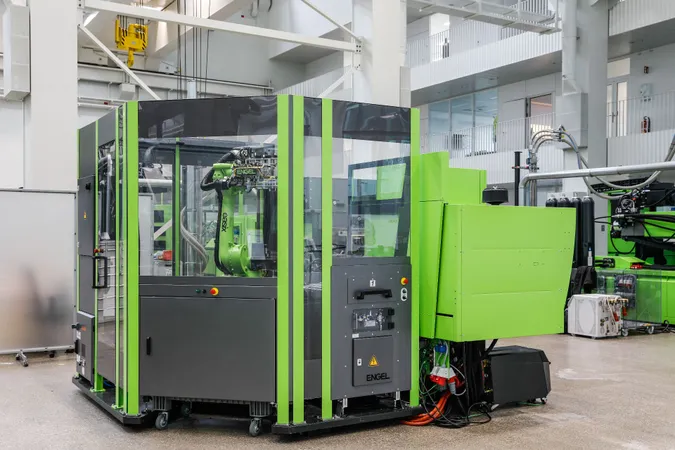
ENGEL demonstrates the process on an ENGEL victory 120 tie-bar-less machine, combined with an easix six-axis robot. This configuration provides enough space for full automation of material feeding, handling within the working area and removal of finished parts.
The automated production cell enables the entire process to run with high precision and reliability, achieving cycle times of less than 60 seconds per blade. This ensures a high level of productivity and makes the technology suitable for industrial series production.
NeoBlade project and the development of a sustainable composite solution
This solution was developed within the NeoBlade project, an interdisciplinary initiative covering the entire value chain – from aeroacoustic design and material development to process automation and sustainability assessment.
Project partners include ALPEX Technologies, Energy Institute at JKU Linz, FACC Operations, Plastic Innovation and TU Wien (Aircraft Systems Research Group).
During development, various thermoplastic systems were analyzed, including composites with recycled carbon fibres. Life cycle assessment results indicate a significant reduction in CO₂ footprint compared to conventional thermoset processes. An additional advantage of thermoplastics is their improved recyclability, allowing production waste and end-of-life components to be returned more easily into the material cycle.
Scalable technology for broader use in the composites industry
In addition to rotor blades for drones, ENGEL is also presenting a high-voltage battery cover made of flame-retardant thermoplastic, measuring 1.3 x 1.8 metres, based on the same tape-sandwich injection moulding technology.
This component has been selected as a finalist for the JEC World Innovation Awards 2026, further confirming the scalability of the technology – from smaller precision parts to large structural components. The battery cover combines low weight, high stiffness, full recyclability and the direct integration of functional elements into the manufacturing process.
ENGEL composite solutions at JEC World 2026
Visitors can explore this technology at the ENGEL booth 5L106 in Hall 5, where the ENGEL team will demonstrate how modern composite manufacturing can successfully combine automation, productivity, sustainability and outstanding component performance.
For companies looking for efficient and future-ready solutions in the field of composite parts, this approach demonstrates how thermoplastic technology can meet growing demands for lower weight, greater functionality and improved sustainability.
Would you like to learn more?
Contact the Neofyton team for more information about ENGEL solutions for composite manufacturing, automation and advanced applications in the plastics industry.
Contact us